
Your 8-step crash course for taking key audiences on a journey
from where they are to where you want them to be
A Course For Programme, Project and Transformation Managers To Help You Explain Change in 8 Easy Steps...
Uncover the insider secrets for improving information flows and collaboration
across your project so stakeholders willingly get involved
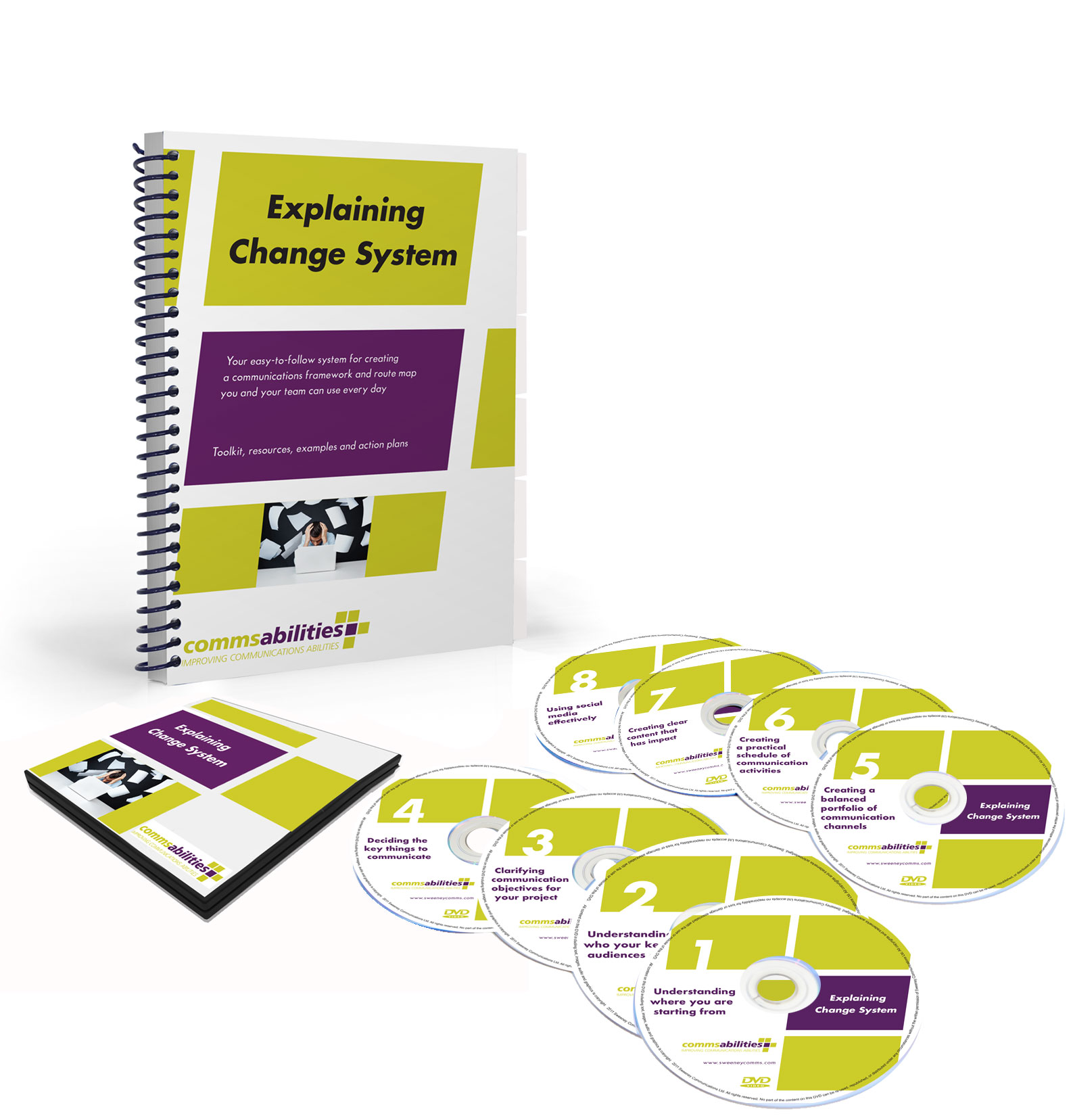
Get Your Copy of The Explaining Change System Here:
Have you been dreaming about creative ways to maintain the energy and freshness of your lengthy project...
...but are feeling like you have lost the confidence of your sponsor and senior executives.
Or trying to decide between the many social media options, which work best in project delivery...
...and finding lots of resistance from leaders who need to be convinced to relinquish control and open up conversations.
Maybe you are struggling with creating a collaborative environment when team members are spread across multiple countries and time zones...
...and you want them to stay up-to-date with what is happening in the project.
Perhaps you want some must-do guidelines for explaining change and helping people face hard truths that cannot be disguised as good news.
Or maybe you have hit resistance to the changes your project is introducing and you want fresh ideas for explaining how things are improving.
If you can relate to one or more of these statements you are not alone.
So many project teams struggle to deliver real and lasting benefits to their organisations because they do not know how to win the support of those people who can make their project a success.
Now for the good news ...
You can uncover the skills of experienced communication professionals in our Explaining Change System
We’ll be delving into the secrets professional communicators learn over many years in their jobs ... so you too can grab your stakeholders’ attention, interest and commitment.
Inside the Explaining Change System
This is a proven strategy that I have developed and used successfully for 10+ years in CRM rollouts, business process re-engineering, office relocations, redeployment, technology rollouts, brand makeovers and culture change.
Every one of my successes comes from following a flexible route map that my clients customise to take their stakeholders along their own project journey.
I love working with clients but know that not all project teams have the budget to hire an external expert. That’s why I’ve created my Explaining Change System.
It’s an easy to follow, step-by-step guide that is very practical and action oriented. I include lots of examples, models, tips, techniques and exercises so you can try out everything we cover.
As you work through each step you will discover how to:
- Create comms activities you can deliver with the resources you have
- Change attitudes and perceptions so your audiences give the support you need for your project to succeed.
Together they are an easy-to-follow system for creating a communications route map that you and your team can use every day.
Here is a sample of what you will develop specifically for your project as you work through the steps:
Assessment of activities so far taking into account usefulness, relevance, impact, issues, culture and risks
Prioritised list of your key audiences based on their impact, influence and how involved you want them to be
SMART objectives for comms that clearly link to and support project deliverables
Overarching themes that give clarity and consistency to your comms activities
Calendar of activities happening in your organisation that allows you to timetable your own comms for maximum attention
Balanced portfolio of communication channels that allow you to communicate effectively with each of your audiences with the minimum of effort
Understanding of the communication strengths in your team and the skill gaps
Easily-updated spreadsheet for managing implementation of each comms activity
Detailed information pack that gives stakeholders background about your project
Route map to introduce social media into your project.
As you can see the Explaining Change System is very practical and directly related to what is happening right now in your project!
What Does Each Step Cover?

Step 1: Understanding where you’re starting from
Delving into your communication activities to date, how effective they’ve been and what you can do differently to increase stakeholder support
Diagnosing where you are starting from – what’s been done by whom, how, when, where and why; what worked and didn’t work
Analysing how you want communications to add value to your project
Plotting the route map to change communications from where you are to where you want them to be
Surfacing strategies to unearth the risks so you can make communications work in practice

Step 2: Understanding who your key audiences are
Considering your key stakeholders’ orientations to the world, their perceptions of your project, the outcomes they expect and the power they have to influence your success
Brainstorming to understand what they are concerned about
Discovering how much they know and how they feel about your project
Segmenting them according to their impact on your project
Deciding how involved you want them to be and making it happen

Step 3: Clarifying communication objectives for your project
Determining communication objectives that will support your overall project aims; ensuring they are relevant and helpful
What’s the bottom line – linking comms activities to your overall project aims - revenues, market share, CSR, et al
Funnelling down to the heart of the problem and identifying the best possible activities and outcomes
Identifying what is most important for activities to support – changing assets, processes, skill levels, attitudes, or culture
How to create specific communication objectives you can measure

Step 4: Deciding the key things to communicate
Understanding the tangible and intangible things that determine whether your audiences will pay attention to and act on the information your provide
Identifying the key messages about your project you want to get across and that convince people to get involved
Tailoring plans and activities to your audiences’ concerns so they feel your project is relevant to them
Creating messages that have credibility with your audiences and that they understand
Sequencing messages so you take your audiences on a journey from where they are to where you want them to be

Step 5: Creating a balanced portfolio of communication channels
Having a range of face2face, print, online and multimedia options you can use to reach each of your audiences in a cost-effective and timely way
Using the 9 PR tools to reach your audiences in ways that are relevant to them and get their attention
Evaluating the pros & cons of communication channels available and choosing the ones that work best for your project
Creating a portfolio of channels that balances cost and production timescales to reach your audiences in the most effective way
Helping your team members produce appealing activities using the mix of face2face, print, online and multimedia channels in your portfolio

Step 6: Creating a practical schedule of activities your team can implement
Discovering simple ways of documenting project communication plans and activities so team members and sponsors understand who does what and by when
Choosing activities you can deliver with the resources you have in your team and organisation
Developing meaningful and measurable objectives linked to your project's deliverables
Determining achievable timescales that are also flexible and help rather than constrain your team
Allocating responsibility for each stage of delivery to ensure an activity happens and meets the objectives you set for it.

Step 7: Creating clear content that has impact
Learning tips and techniques you and your team members
can use to quickly create content for communication activities that will be easy for audiences to understand and respond to
Developing credible content that changes views and persuades people to act
Creating an easy-to-read and understand information pack for a consistent view of your project
Using a précis to structure what you want to say
Applying the 12 golden rules for successful writing; they are amazingly simple

Step 8: Using social media effectively
Uncovering how to introduce social media into your project for improving relationships between team members and with other stakeholders
Using social media to connect with your audiences and provide them with information about your project
Dealing with the fear of losing control and other concerns that hold people back from using social media
Choosing the apps that are most relevant to your project and your audiences
Using social media to improve collaboration within the project team, whether you are in the same office or scattered across the globe
Just imagine being able to work through these steps in comfort at a time that works best for you!
Each step I share a part of my proven strategy for communicating projects. You will gradually build up a communications framework and schedule of activities you and your team can use each day.
Not only that, each step includes at least four tangible tools you can easily tailor to your project’s needs, as well as to your team’s capabilities. These tools work for all types of project and all sizes of team. I know because I’ve tested them over and over again with my clients.
Everything you learn will be at your fingertips for many years to come. Here are the resources you will receive:
1. 8 DVDs – containing 12 hours of video instruction
Join me as we walk through each of the steps one at a time, and immerse yourself in the content both visually and aurally – it’s as if we are learning together.
2. A comprehensive workbook – the perfect companion to the DVDs
Just like on a traditional workshop you have an invaluable manual containing detailed background material for the topics covered in each step, plus plenty of room for your own notes.
3. Bespoke project communications plan
The exercises build into a practical communications framework and schedule of activities that are tailored to your project and that you and your team can use every day.
4. Step-by-step action plan
With each step you have a systematic process to take at least one thing you have learnt back into your job. Its just one step that, when implemented, will make a BIG difference to the success of your project.
5. A private feedback session with me
When you have completed all eight steps you can, if you wish, send me your communications plan for my assessment. Once I’ve had a chance to read it in detail we will have a private call to talk through my feedback.
Additionally, I’m including a special bonus...
6. The practical style guide Write for your Reader
With this guide you can avoid the most common language, spelling, grammar and punctuation mistakes. Instead you will write more vividly and speak directly to your audiences.
Listen to what other people say about the Explaining Change System

"What I do is all about HR change and transformation, we can’t achieve very much if we don’t communicate. I had high-level understanding, through your system I also have the detail and how to stitch communication activities together. Typically I work with top teams who often want their internal communicators to sell the change internally. Now I can ask the right questions and guide them. You’ve made me aware of my skill deficiencies but I don’t feel threatened. Instead I feel it is something I can cope with and develop".
Christine Bennett
Senior HR manager
Public Sector

"Thank you for what you share in this system.
My overall awareness of communication in all forms has increased and I’m less afraid of social media. The writing step I found very interesting.
I’m now more purposeful in my communication with peers and upper management, and able to be more considerate of them".
Elaine Tomkinson
Associate Director
Eisai

"The system has built my confidence in being able to say and do the right things when communicating with others.
What I thought I was doing right I have discovered I am doing right and I am going in the right direction.
It has also helped me understand what communicators do so that I can support them more effectively".
Pam Harris
Virtual PA
www.freelanceconnections.com
“Okay – so what’s the cost for this incredible content?” I hear you ask…
I’ve thought long and hard about sharing such valuable information outside one2one mentoring and inhouse training – after all it’s taken me 25+ years of experience to learn. It’s the stuff we won’t find in text books!
Also, I wonder, will you value the content if it feels to easy to acquire? I’m going to take this risk and price so that I can help the people who can gain most from what I share. I’ve settled on a price that is affordable, whether you are paying yourself or asking your company to pay.
That’s why the entire Explaining Change System is £375 including workbook, dvds and personalised input from me.
“If you always deliver on time and to budget, have all the leadership support you want
and need, a highly motivated project team and end users who are open to
changing the ways they work, then you are a communications maestro.
You already know how to explain change effectively.
But if you have a little niggle of doubt, then let my guide fill the gap with practical knowledge you and your team can use each and every day.” Jo Ann Sweeney
You may be wondering what qualifies me to charge for my knowledge and experience, so let me tell you a little about myself...

Jo Ann Sweeney
Founder and Director of Sweeney Comms
I am a communications consultant who helps teams win the support of their sponsors, senior executives and end users.
I'm known for my ability to clearly explain complex information so audiences understand both the detail and the relevance to themselves.
I specialise in helping clients develop practical communication plans they can implement with the resources they have.
Clients include Inmarsat, Eisai, FSB, BT, Telefónica UK, London Councils and Transport for London. My results-focused approach ensures communication activities achieve their objectives, meet audience expectations, make best use of resources and deliver value to the bottom line.
Transformation programmes include CRM rollouts, business process reengineering, office relocations, redeployment, technology rollouts, re-brands and culture change.
I have more than 25 years experience and am a trained journalist, chartered marketer, fellow of the Institute of Internal Communications and member of the Chartered Institute of Public Relations.
So are you ready to join me and uncover the secrets for improving information flows so stakeholders understand your
project and remain involved?
Yes please Jo Ann, I’m ready for my copy of the Explaining Change System for only £251.25 instead of £375 and looking forward to improving information flows and collaboration with my stakeholders...
I'm looking forward to working with you.
Best wishes,
Jo Ann Sweeney
Sweeney Communications Ltd
Thornton Heath,
Surrey
CR7 8DZ,
United Kingdom
Registered in England no.: 3982361
www.sweeneycomms.com